

There’s a lot of excitement right now about AI and automation saving advertisers time. We wanted to know what’s actually happening today: where the manual work really lives inside Google Ads, and how much of it there still is.
So we pulled the change history log for 72,358 Google Ads accounts over six months. Every one of the 578 million changes made to those accounts got labeled by how it was made: a person clicking through the website, software calling the Ads API, a bulk spreadsheet upload, an Ads Script, or one of a handful of smaller automated channels.
The headline number: 62.4 million of those changes, 10.8% of the total, were made by a person, by hand. That’s a bigger number than we expected going in. What surprised us even more was how often people were doing it.
The most interesting finding: it’s not about how much, but it’s about how often
Look at raw volume and automation wins easily: 241 million changes came from feed and automation platforms, another 146 million from software using the Ads API. Manual clicking, at 62.4 million, barely registers by comparison.
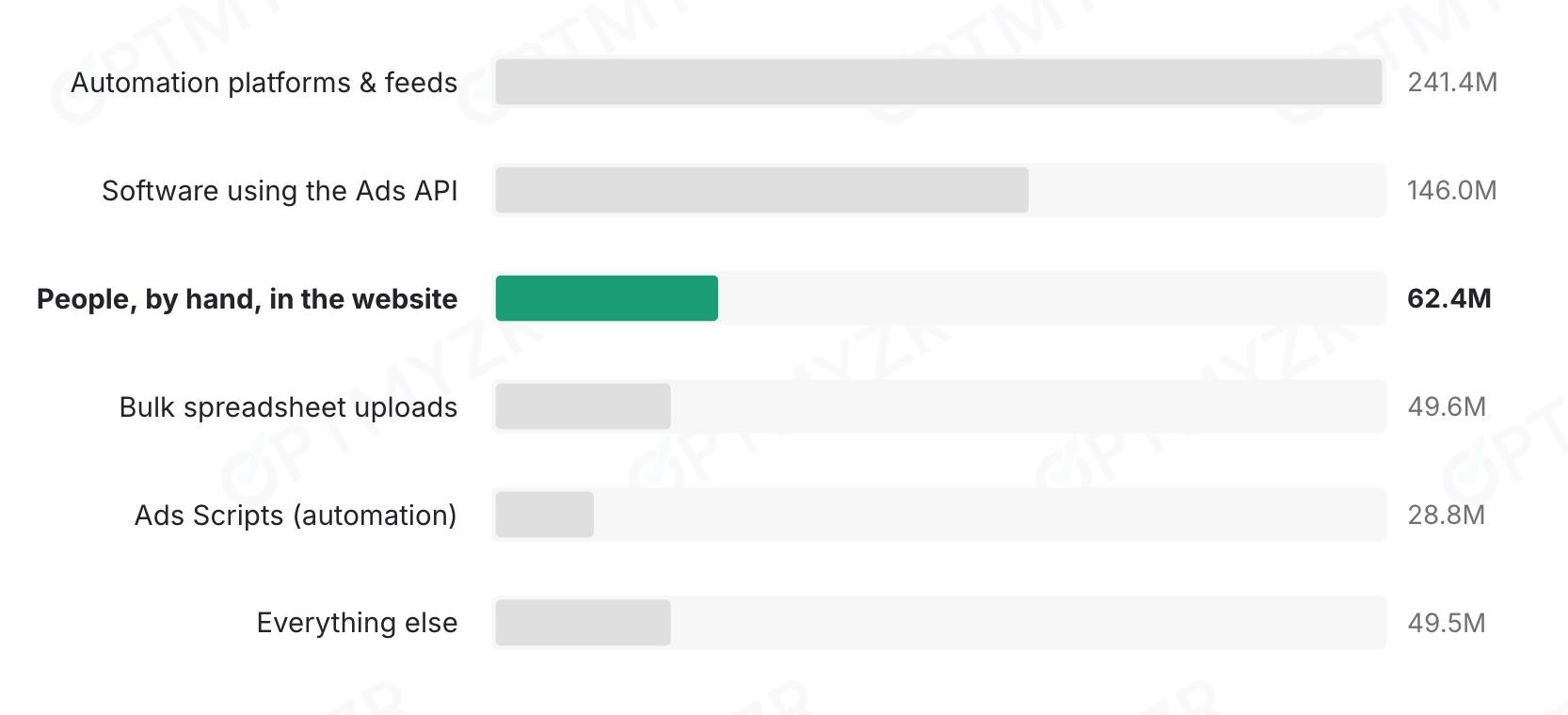
Volume of changes made by method. Feb-Jul 2026. 72,358 accounts using Optmyzr
But volume isn’t the same as frequency. When you count sessions, meaning one person or process making a burst of changes in one account, the picture flips. Software using the API ran 1.99 million sessions. People clicking through the website ran 1.34 million, more than automation platforms and feeds (1.11 million) and more than Ads Scripts (1.09 million) individually. Manual clicking is the second most common way an account changes, right behind the API, and ahead of every pure-automation channel.
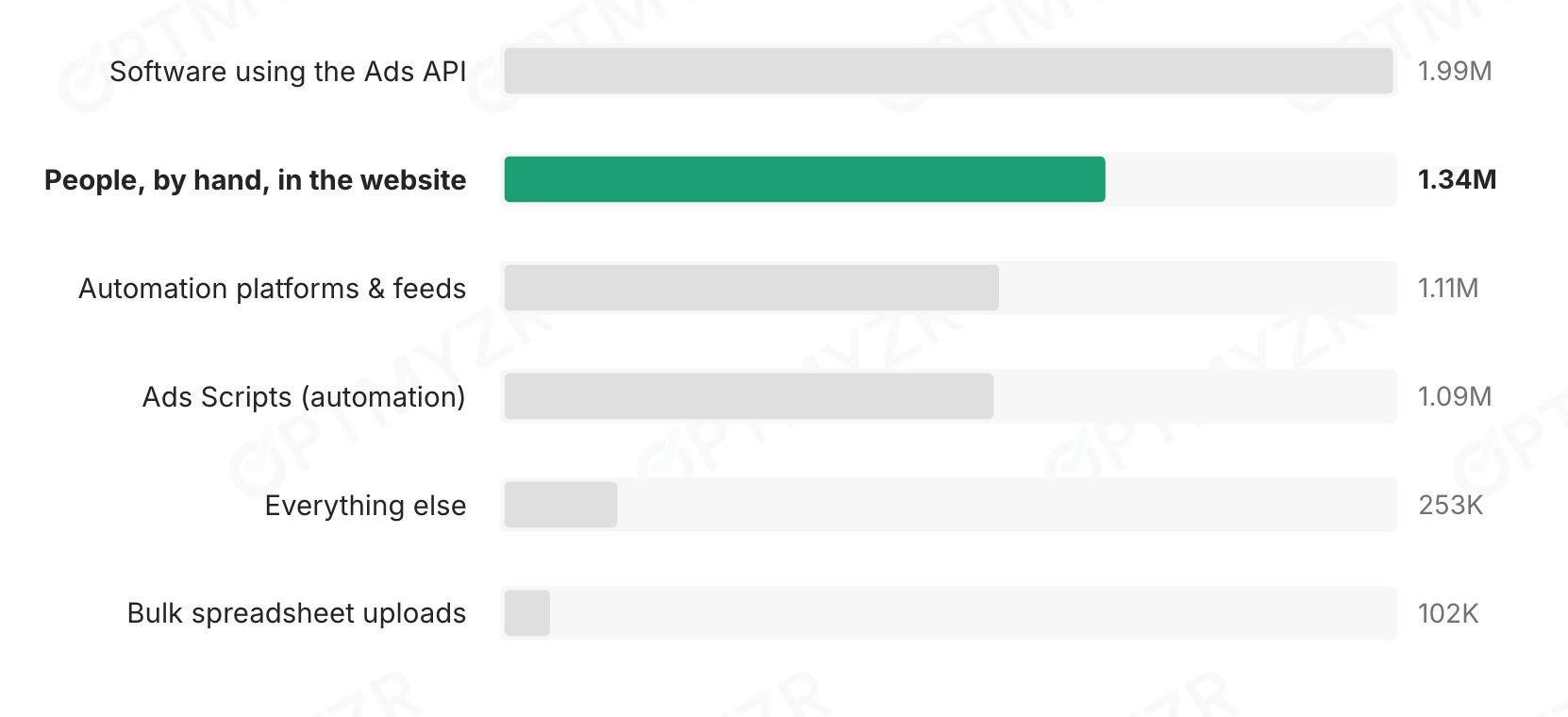
Number of sessions to make changes in Google Ads broken down by method of access. Feb-Jul 2026. 72,358 accounts using Optmyzr
Put those two numbers side by side and a clear pattern emerges: manual sessions make up 22.8% of all activity, but only 10.8% of total changes. People start work about as often as software does. They just move a lot less per sitting. That’s the definition of time-consuming: a lot of starts, not much finished per start.
What manual work actually looks like
We grouped every burst of manual activity into four patterns:
- One change at a time, a single, one-off edit with no repetition
- Doing the same thing, over and over, three or more edits of the exact same kind back to back (always budgets, always bids, always status flips)
- Doing a lot of changes in one sitting, ten or more changes of any kind mixed together
- Spanning multiple campaigns at once, a single sitting touching three or more campaigns
That third pattern, sheer volume, is where most of the pain lives. A quarter of all manual sessions are bulk jobs of 10 or more changes, and those bulk jobs account for 92% of all manual change volume. Do the math on the time and it comes out to roughly 43,966 hours of clicking across 16,839 people in six months, or about 44 people working full time on nothing but repetitive manual edits. At a conservative $40 an hour loaded cost, that’s close to $1.8 million in specialist time. That habit touched 39,874 accounts, 55% of every account in the study.
Nine of every ten hand-made changes are about targeting: adding or removing keywords, campaign-level targeting, negatives. Budgets are only 1% of manual volume, but they’re the single most repeated chore: 130,800 budget-editing sessions in six months across 20,141 accounts, with 32,000 of those sessions changing 10 or more budgets in one sitting and 3,164 people doing it more than five times. That’s not a one-off cleanup. That’s a routine.
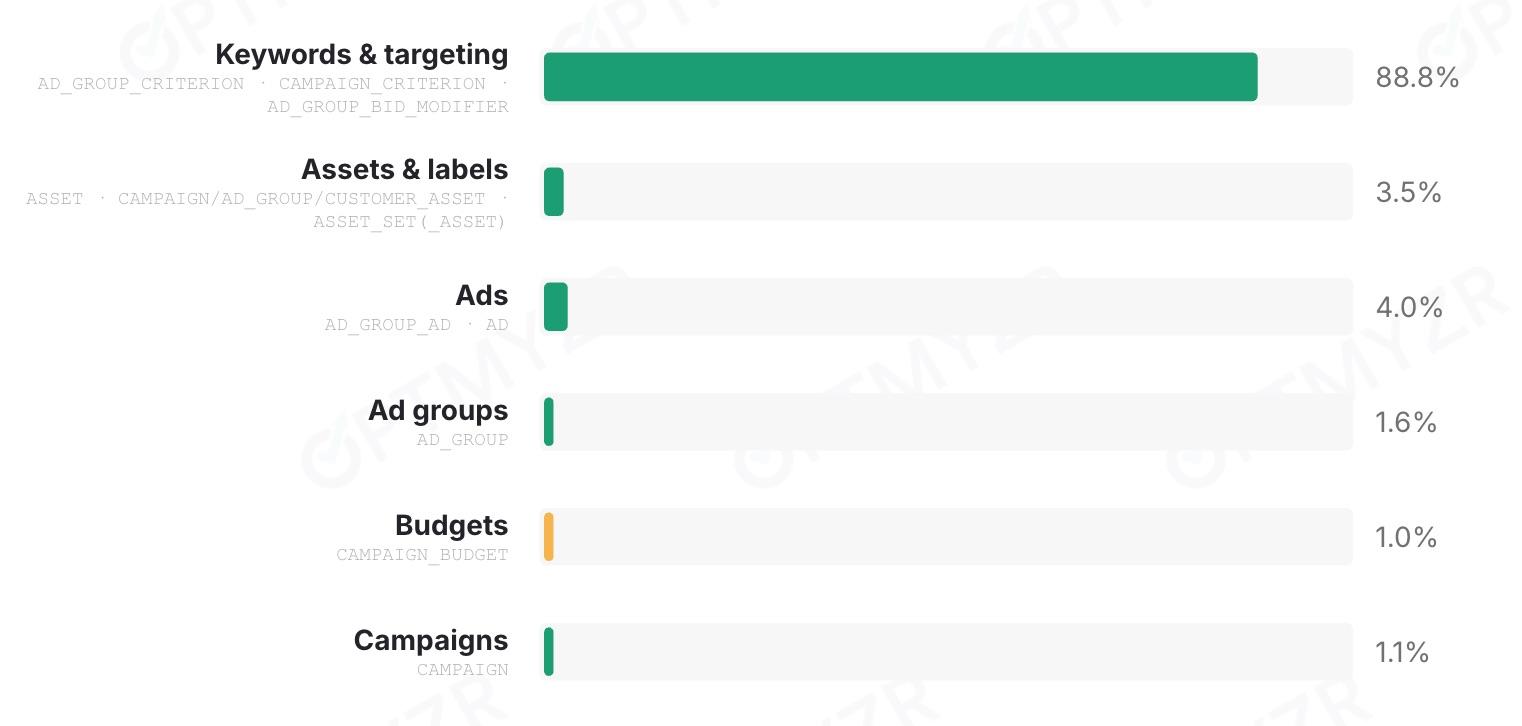
Type of manual changes made by method. Feb-Jul 2026. 72,358 accounts using Optmyzr
The other repeated chore worth calling out: pausing and enabling keywords across campaigns. 22,187 sessions paused or enabled keywords across three or more campaigns in one sitting, averaging around 600 keyword flips spread over seven campaigns each time. Keyword on/off sessions overall: 132,000 of them, median 30 flips per session.
Bulk tools exist. Almost nobody reaches for them
Google already has a built-in bulk-editing route: spreadsheet uploads through Tools, Bulk actions, Uploads. About 3,100 accounts use it. Compare that to the roughly 40,000 accounts doing bulk-scale work by hand in the website interface, and the adoption gap is stark: 13 times more accounts choose to grind through the UI than reach for the tool built to replace that grind.
That’s the part worth sitting with. People don’t adopt spreadsheet tooling. They work through the interface by hand, over and over. If the fix were simply “teach people about bulk uploads,” adoption would already be higher. It isn’t, which suggests the real opportunity is putting one-click bulk actions inside the workflow people already use, not asking them to learn a new one.
We asked advertisers why, and the answer surprised us
The data tells you what’s happening. It doesn’t tell you why people keep doing it by hand when tools exist to automate it. So PPC headhunter and LinkedIn commentator Sam Brand ran an informal poll of his network right around Labor Day, asking a direct question: why are you still clicking through the Google Ads UI by hand instead of using bulk tools?
64 people answered:
- 40% said they don’t trust automation with client budgets
- 34% said it’s simply habit, it’s what they know
- 13% said hands-on control is expected of them, by a client or an employer
- 10% said the tools they have don’t actually do what they need
That first number is the one worth pausing on. We went into this assuming habit would dominate, and it’s a close second at 34%. But the single biggest reason PPC professionals gave for still doing this work by hand wasn’t comfort or expectation. It was trust. Four in ten said they simply don’t trust automation touching a live account.
That reframes the whole adoption gap. It’s not that advertisers don’t know bulk tools exist, or that they’re too attached to old habits to change. A meaningful share of the industry has looked at automation and decided the risk isn’t worth it. Any tool asking people to move from 62 million manual changes to something automated has to answer the trust question directly, not just the convenience one.
What this means if you’re managing PPC accounts
Ninety-two percent of manual volume happens in sittings of 10 or more changes. That’s the definition of work a one-click tool should be doing. Optmyzr already builds toward exactly that: a bulk budget editor, a rule engine for cross-campaign keyword changes, fast negative-keyword capture routed to shared lists, one-click bid adjustments, and bulk campaign and ad group creation, plus the ability to manage smart bidding targets like tCPA and tROAS at scale to improve profitability or sales volume.
But given what the poll turned up, the more interesting question for a lot of teams isn’t which bulk tool to try first. It’s what would actually need to be true about a tool before you trusted it with a live account. That’s a harder problem than a better UI, and it’s the one we think is worth solving next.
Methodology: full details on data collection, the definition of a “burst,” and every stat cited above are in the complete study deck, available for download here.