---
title: "Broad Match is Winning the Budget War. Is It Winning on Performance Too?"
serpTitle: "Broad Match is Winning the Budget War. Is It Winning on Performance Too?"
description: "We analyzed 30,000 Google Ads accounts to see which match type actually performs best. Broad match is winning the budget war — the results tell a more complicated story."
date: "2026-05-11"
lastmod: "2026-05-11 10:36:04 +0000 UTC"
author: "Frederick Vallaeys "
authorTitle: "Co-founder & CEO"
authorCompany: "Optmyzr"
url: "https://www.optmyzr.com/blog/google-ads-match-type-performance/"
categories:
- "Data Studies"
- "Expert Series"
featured_image: "/forestry/broad-match-is-winning-the-budget-war-is-it-winning-the-performance-war-1.png"
---
# Broad Match is Winning the Budget War. Is It Winning on Performance Too?
> We analyzed 30,000 Google Ads accounts to see which match type actually performs best. Broad match is winning the budget war — the results tell a more complicated story.
**Author:** Frederick Vallaeys | **Published:** May 11, 2026
**Categories:** Data Studies, Expert Series
---
Everyone has an opinion on match types. Broad match advocates will tell you Smart Bidding has made tight keyword control largely unnecessary. Exact match loyalists aren't ready to hand the keys to Google just yet. And phrase match users wonder if anyone still remembers they exist.
We decided to look at the data and let it do the talking.
For this study, we analyzed **30,000 Google Ads accounts** for February 2026, across all Search campaigns with active keyword spend. We looked at non-branded campaigns across three lenses: all account types combined, ecommerce-focused accounts (those with measurable conversion value), and lead gen accounts (those without revenue tracking). We also looked at branded campaigns separately, and tracked how advertiser spend has shifted across match types since 2022.
Here's what we found.
---
## Exact match is losing share against broad and phrase
Since 2022, exact match has lost nearly 10 percentage points of spend share, while broad match has climbed steadily to become the dominant match type by budget. Phrase match dipped in 2024 before recovering through 2026.
This tells a clear story about advertiser sentiment: more people are trusting Google's AI with broader targeting. That trust isn't unreasonable — Smart Bidding has genuinely matured, and broad match today is a fundamentally different product than it was four years ago. Whether the performance data has kept pace with that shift in confidence is what we set out to answer.
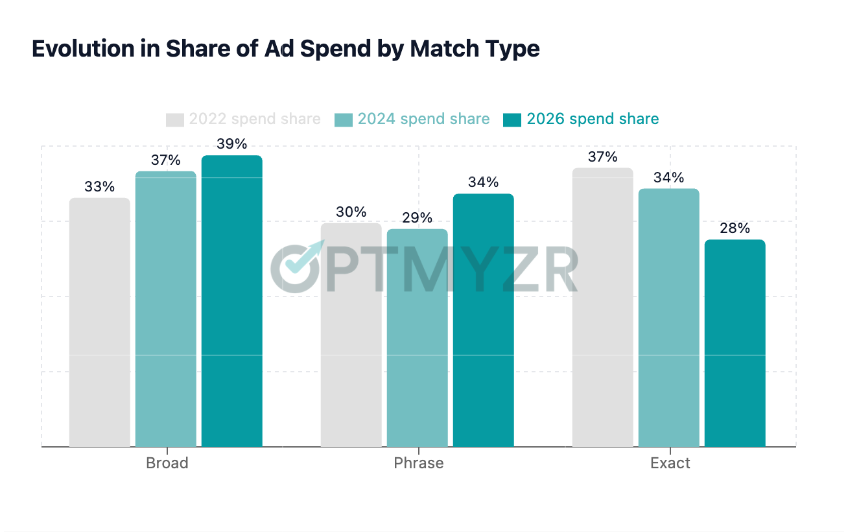 Exact match spend share declined by 9.5% between 2022 and 2026, while phrase and broad match shares increased. The landscape of keyword match types is shifting, with a clear trend away from exact match. This data illustrates a strategic pivot towards broader matching, suggesting advertisers are adapting to evolving search algorithms and user behavior.
---
## Which match type performs best for non-branded campaigns — all account types?
The cards below show the single best-performing match type for each key metric compared to the worst performing across all non-branded campaigns.
Exact match spend share declined by 9.5% between 2022 and 2026, while phrase and broad match shares increased. The landscape of keyword match types is shifting, with a clear trend away from exact match. This data illustrates a strategic pivot towards broader matching, suggesting advertisers are adapting to evolving search algorithms and user behavior.
---
## Which match type performs best for non-branded campaigns — all account types?
The cards below show the single best-performing match type for each key metric compared to the worst performing across all non-branded campaigns.
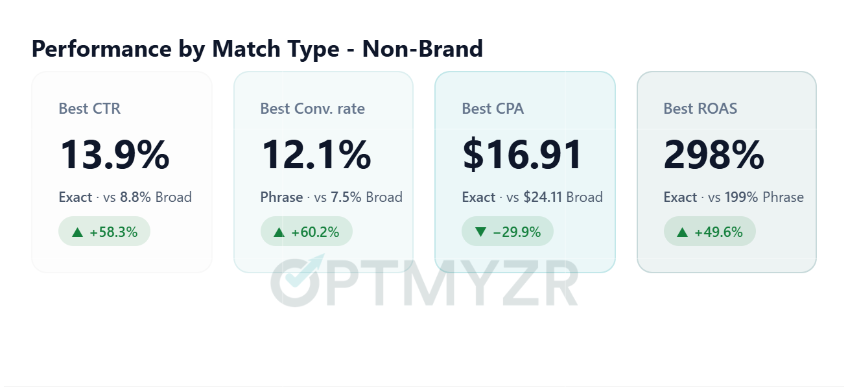 {{< figure src="/forestry/image-29.png" alt="Performance Metrics by Match Type for non-brand campaigns. 30,000 Google Ads Search accounts in Optmyzr - Feb 2026" caption="Performance Metrics by Match Type for non-brand campaigns. 30,000 Google Ads Search accounts in Optmyzr - Feb 2026" >}}
Across the board, exact match leads on efficiency. The underlying reason isn't surprising: when a keyword closely matches what someone typed, the intent signal is cleaner, the ad is more relevant, and the click is more likely to convert.
Broad match generates significantly more volume, but that volume comes at a cost. Without strong Smart Bidding signals and a well-maintained negative keyword list, broad match can spend a lot chasing traffic that was never going to convert.
What often gets overlooked is how phrase match performs relative to its cost. It accounts for the largest share of non-brand spend, but consistently punches above its weight on conversions. The implication is that phrase match is attracting traffic that's genuinely close to acting — specific enough to be relevant, broad enough to reach people who didn't type the exact keyword you bid on.
{{< figure src="/forestry/image-30.png" alt="Share of spend & conversions by Match Type for non-brand campaigns. 30,000 Google Ads Search accounts in Optmyzr - Feb 2026" caption="Share of spend & conversions by Match Type for non-brand campaigns. 30,000 Google Ads Search accounts in Optmyzr - Feb 2026" >}}
---
## Does it look different for e-commerce accounts?
When we narrow the lens to accounts with measurable conversion value (our proxy for ecommerce advertisers) the gaps widen, and a few things become clearer.
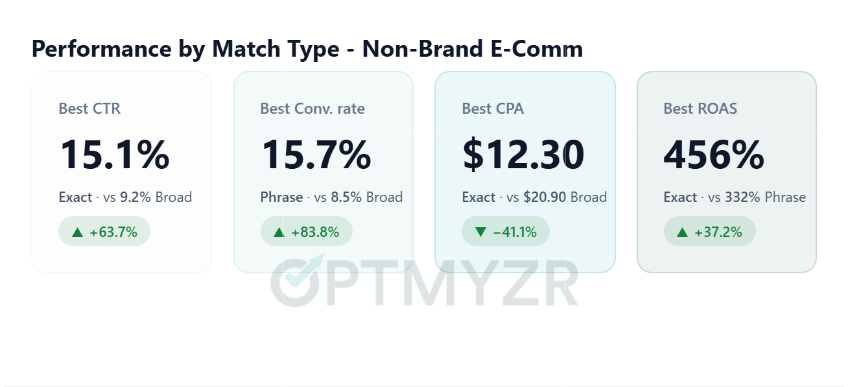 {{< figure src="/forestry/image-32.png" alt="Performance Metrics by Match Type for non-brand e-comm campaigns. 30,000 Google Ads Search accounts in Optmyzr - Feb 2026." caption="Performance Metrics by Match Type for non-brand e-comm campaigns. 30,000 Google Ads Search accounts in Optmyzr - Feb 2026." >}}
{{< figure src="/forestry/image-33.png" alt="Share of spend & conversions by Match Type for non-brand e-comm campaigns. 30,000 Google Ads Search accounts in Optmyzr - Feb 2026." caption="Share of spend & conversions by Match Type for non-brand e-comm campaigns. 30,000 Google Ads Search accounts in Optmyzr - Feb 2026." >}}
Exact match pulls further ahead on ROAS and CPA. In e-commerce, where someone searching for a specific product name is often one click from a purchase, precise keyword matching is especially powerful. The intent signal is already strong; exact match just makes sure the ad shows up for it reliably.
The more interesting finding is what happens to phrase match's conversion rate in this segment: it posts the highest of any match type across the entire study. This likely reflects how phrase match works in ecommerce contexts: capturing shoppers who are using slightly varied product language, still in buying mode, but not quite using the exact terms you've targeted. Those are high-quality clicks.
Broad and phrase also end up nearly level on ROAS in this view. For anyone who's been defaulting to broad on the assumption that it has a clear AI-driven advantage, the data suggests it's a closer race than expected, at least in accounts where the algorithm has strong conversion value signals to learn from.
---
## What about lead gen accounts?
Lead gen accounts tell a different story, and it's one that's easy to miss when you only look at aggregate data.
The cards below show the best-performing match type for each metric in non-branded, lead gen-focused accounts — those without revenue tracking, where conversion volume rather than conversion value is the primary signal.
{{< figure src="/forestry/image-32.png" alt="Performance Metrics by Match Type for non-brand e-comm campaigns. 30,000 Google Ads Search accounts in Optmyzr - Feb 2026." caption="Performance Metrics by Match Type for non-brand e-comm campaigns. 30,000 Google Ads Search accounts in Optmyzr - Feb 2026." >}}
{{< figure src="/forestry/image-33.png" alt="Share of spend & conversions by Match Type for non-brand e-comm campaigns. 30,000 Google Ads Search accounts in Optmyzr - Feb 2026." caption="Share of spend & conversions by Match Type for non-brand e-comm campaigns. 30,000 Google Ads Search accounts in Optmyzr - Feb 2026." >}}
Exact match pulls further ahead on ROAS and CPA. In e-commerce, where someone searching for a specific product name is often one click from a purchase, precise keyword matching is especially powerful. The intent signal is already strong; exact match just makes sure the ad shows up for it reliably.
The more interesting finding is what happens to phrase match's conversion rate in this segment: it posts the highest of any match type across the entire study. This likely reflects how phrase match works in ecommerce contexts: capturing shoppers who are using slightly varied product language, still in buying mode, but not quite using the exact terms you've targeted. Those are high-quality clicks.
Broad and phrase also end up nearly level on ROAS in this view. For anyone who's been defaulting to broad on the assumption that it has a clear AI-driven advantage, the data suggests it's a closer race than expected, at least in accounts where the algorithm has strong conversion value signals to learn from.
---
## What about lead gen accounts?
Lead gen accounts tell a different story, and it's one that's easy to miss when you only look at aggregate data.
The cards below show the best-performing match type for each metric in non-branded, lead gen-focused accounts — those without revenue tracking, where conversion volume rather than conversion value is the primary signal.
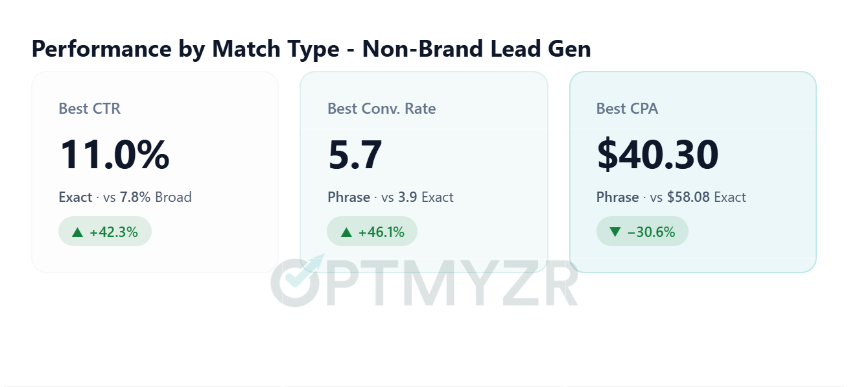 {{< figure src="/forestry/image-35.png" alt="Performance Metrics by Match Type for non-brand lead gen campaigns. 30,000 Google Ads Search accounts in Optmyzr - Feb 2026" caption="Performance Metrics by Match Type for non-brand lead gen campaigns. 30,000 Google Ads Search accounts in Optmyzr - Feb 2026" >}}
Phrase match dominates here in a way it doesn't in e-commerce. It holds the largest share of both spend and conversions, and the gap over the other two match types is wider than in any other segment. The likely reason: lead gen campaigns often rely on intent-adjacent keywords, where someone searching a loosely related query can still be a qualified prospect. Phrase match is well-suited to that kind of traffic — it reaches beyond exact terms without opening the floodgates the way broad match can.
Broad match, by contrast, loses its footing more noticeably in lead gen than in e-commerce. Without conversion value data to guide Smart Bidding, the algorithm has less to work with, and the efficiency gap shows more clearly.
{{< figure src="/forestry/image-36.png" alt="Share of spend & conversions by Match Type for non-brand lead gen campaigns. 30,000 Google Ads Search accounts in Optmyzr - Feb 2026." caption="Share of spend & conversions by Match Type for non-brand lead gen campaigns. 30,000 Google Ads Search accounts in Optmyzr - Feb 2026." >}}
---
## What about branded campaigns?
Branded campaigns tell a particularly clear story, and one that often gets less attention than it deserves.
Exact match on branded terms leads on almost every major metric: CTR, conversion share, and ROAS. The only exception is that for conversion rate, phrase match wins and performs 36% better than broad match, but it is in a near tie with exact match (8.22% vs 8.18%).
The reason is fairly intuitive: when someone types your brand name, they're already looking for you. An exact match keyword captures that moment precisely. Broad or phrase match on the same terms introduces variability — the ad might show for adjacent queries or lookalike searches that happen to share vocabulary with your brand, diluting the signal.
{{< figure src="/forestry/image-35.png" alt="Performance Metrics by Match Type for non-brand lead gen campaigns. 30,000 Google Ads Search accounts in Optmyzr - Feb 2026" caption="Performance Metrics by Match Type for non-brand lead gen campaigns. 30,000 Google Ads Search accounts in Optmyzr - Feb 2026" >}}
Phrase match dominates here in a way it doesn't in e-commerce. It holds the largest share of both spend and conversions, and the gap over the other two match types is wider than in any other segment. The likely reason: lead gen campaigns often rely on intent-adjacent keywords, where someone searching a loosely related query can still be a qualified prospect. Phrase match is well-suited to that kind of traffic — it reaches beyond exact terms without opening the floodgates the way broad match can.
Broad match, by contrast, loses its footing more noticeably in lead gen than in e-commerce. Without conversion value data to guide Smart Bidding, the algorithm has less to work with, and the efficiency gap shows more clearly.
{{< figure src="/forestry/image-36.png" alt="Share of spend & conversions by Match Type for non-brand lead gen campaigns. 30,000 Google Ads Search accounts in Optmyzr - Feb 2026." caption="Share of spend & conversions by Match Type for non-brand lead gen campaigns. 30,000 Google Ads Search accounts in Optmyzr - Feb 2026." >}}
---
## What about branded campaigns?
Branded campaigns tell a particularly clear story, and one that often gets less attention than it deserves.
Exact match on branded terms leads on almost every major metric: CTR, conversion share, and ROAS. The only exception is that for conversion rate, phrase match wins and performs 36% better than broad match, but it is in a near tie with exact match (8.22% vs 8.18%).
The reason is fairly intuitive: when someone types your brand name, they're already looking for you. An exact match keyword captures that moment precisely. Broad or phrase match on the same terms introduces variability — the ad might show for adjacent queries or lookalike searches that happen to share vocabulary with your brand, diluting the signal.
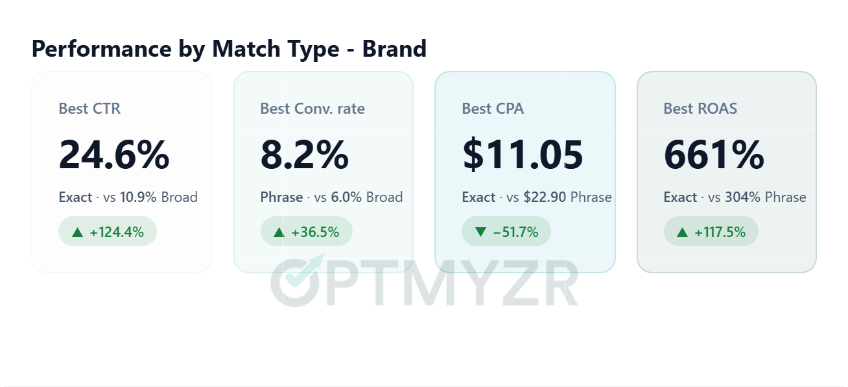 {{< figure src="/forestry/image-38.png" alt="Performance Metrics by Match Type for brand campaigns. 30,000 Google Ads Search accounts in Optmyzr - Feb 2026." caption="Performance Metrics by Match Type for brand campaigns. 30,000 Google Ads Search accounts in Optmyzr - Feb 2026." >}}
{{< figure src="/forestry/image-39.png" alt="Share of spend & conversion by Match Type for brand campaigns. 30,000 Google Ads Search accounts in Optmyzr - Feb 2026." caption="Share of spend & conversion by Match Type for brand campaigns. 30,000 Google Ads Search accounts in Optmyzr - Feb 2026." >}}
The spend-to-conversion ratio makes the stakes concrete. Exact match generates a disproportionate share of branded conversions relative to what it costs, while broad match does the opposite: more spend, fewer conversions.
There are valid reasons to run other match types on branded terms: capturing adjacent queries, testing messaging, filling gaps in exact match coverage. But this data suggests those decisions deserve more scrutiny than they typically get.
---
## So what does this all mean?
A few things come into focus when you look across all segments together.
**Exact match is losing share but not losing relevance.** The shift toward broad isn't because exact match has stopped working — the performance case is as strong as ever. It's because advertisers have grown more comfortable with automation, and Google has made broad match easier to justify. Those are reasonable influences, but they're not the same as exact match underperforming.
**Phrase match is the most consistent overperformer.** Across ecommerce and lead gen alike, it punches above its weight. Its recovery in spend share through 2026 may reflect advertisers rediscovering this balance: enough control to stay relevant, enough flexibility to catch intent-aligned traffic that exact match misses.
**Broad match is a bet on the algorithm — and** [**the conditions matter**](https://www.optmyzr.com/blog/choose-best-google-ads-keyword-match-type/)**.** It works best when Smart Bidding has rich signals to learn from, whether that's conversion value in ecommerce or strong conversion volume in lead gen. Remove those conditions and the efficiency gap becomes harder to overlook.
The accounts getting the most from match types tend to use all three deliberately: exact for high-intent, high-value keywords; phrase as the day-to-day workhorse; broad for discovery and scale. The question worth asking isn't which match type is best. It's whether you're using each one for the right job in your account.
If you want to keep pulling on this thread, our RSA performance study looks at what actually drives ad efficiency once the right keywords are in place. Spoiler: it's not Ad Strength.
Read the study here.
---
*This study covers February 2026 data across 30,000 Google Ads Search accounts. Ecommerce accounts are defined as those with measurable conversion value. Lead gen accounts are those without revenue tracking. Branded analysis covers all accounts without segment filtering.*
---
*Source: [Broad Match is Winning the Budget War. Is It Winning on Performance Too?](https://www.optmyzr.com/blog/google-ads-match-type-performance/)*
*© Optmyzr. All rights reserved.*
{{< figure src="/forestry/image-38.png" alt="Performance Metrics by Match Type for brand campaigns. 30,000 Google Ads Search accounts in Optmyzr - Feb 2026." caption="Performance Metrics by Match Type for brand campaigns. 30,000 Google Ads Search accounts in Optmyzr - Feb 2026." >}}
{{< figure src="/forestry/image-39.png" alt="Share of spend & conversion by Match Type for brand campaigns. 30,000 Google Ads Search accounts in Optmyzr - Feb 2026." caption="Share of spend & conversion by Match Type for brand campaigns. 30,000 Google Ads Search accounts in Optmyzr - Feb 2026." >}}
The spend-to-conversion ratio makes the stakes concrete. Exact match generates a disproportionate share of branded conversions relative to what it costs, while broad match does the opposite: more spend, fewer conversions.
There are valid reasons to run other match types on branded terms: capturing adjacent queries, testing messaging, filling gaps in exact match coverage. But this data suggests those decisions deserve more scrutiny than they typically get.
---
## So what does this all mean?
A few things come into focus when you look across all segments together.
**Exact match is losing share but not losing relevance.** The shift toward broad isn't because exact match has stopped working — the performance case is as strong as ever. It's because advertisers have grown more comfortable with automation, and Google has made broad match easier to justify. Those are reasonable influences, but they're not the same as exact match underperforming.
**Phrase match is the most consistent overperformer.** Across ecommerce and lead gen alike, it punches above its weight. Its recovery in spend share through 2026 may reflect advertisers rediscovering this balance: enough control to stay relevant, enough flexibility to catch intent-aligned traffic that exact match misses.
**Broad match is a bet on the algorithm — and** [**the conditions matter**](https://www.optmyzr.com/blog/choose-best-google-ads-keyword-match-type/)**.** It works best when Smart Bidding has rich signals to learn from, whether that's conversion value in ecommerce or strong conversion volume in lead gen. Remove those conditions and the efficiency gap becomes harder to overlook.
The accounts getting the most from match types tend to use all three deliberately: exact for high-intent, high-value keywords; phrase as the day-to-day workhorse; broad for discovery and scale. The question worth asking isn't which match type is best. It's whether you're using each one for the right job in your account.
If you want to keep pulling on this thread, our RSA performance study looks at what actually drives ad efficiency once the right keywords are in place. Spoiler: it's not Ad Strength.
Read the study here.
---
*This study covers February 2026 data across 30,000 Google Ads Search accounts. Ecommerce accounts are defined as those with measurable conversion value. Lead gen accounts are those without revenue tracking. Branded analysis covers all accounts without segment filtering.*
---
*Source: [Broad Match is Winning the Budget War. Is It Winning on Performance Too?](https://www.optmyzr.com/blog/google-ads-match-type-performance/)*
*© Optmyzr. All rights reserved.*