


If you manage Google Ads, you have probably seen the warning by now. Starting August 17, 2026, and rolling out over several weeks, Google is changing how target-based bidding behaves when campaigns are limited by budget.
Most of the advice has been simple: if actual CPA is below Target CPA, lower the target. If actual ROAS is above Target ROAS, raise it.
That advice is correct. But it is also incomplete. How Google achieves this outcome determines what else you should closely monitor.
As Google makes Smart Bidding more literal, the target stops being a loose suggestion and becomes a more powerful control knob. A good objective becomes more useful. And a bad one becomes more dangerous.
Why there was a gap between target and actual performance
Let me illustrate with a simple example. Say you tell a colleague to pick up snacks for the office.
You give them two instructions: spend no more than $100, and keep the average cost per snack at or below $2.
The shopper enters the store, happens upon an aisle with reasonably priced snacks and fills their cart with a hundred tasty snacks for $1 each and returns with an empty wallet. The result comfortably beats the $2 target, but the $2 target never became the active constraint. The shopper ran out of budget first.
Now imagine they are instructed to operate closer to a $2 average while the $100 budget remains. In a simplified example, the same spend may buy fifty snacks instead of a hundred. The budget is still respected; the efficiency target has simply become more authoritative.
This is not Google’s algorithm but it captures the economics. A useful way to model Smart Bidding, supported by Google-authored research, “Auto-bidding and Auctions in Online Advertising: A Survey”, is as an optimizer that maximizes conversions or conversion value while staying within both a budget cap and an average-efficiency constraint.
This paper studies systems with exactly these kinds of interacting instructions. When the budget runs out first, the machine has to ration spending. It naturally favors opportunities with the strongest expected return per dollar. That is how a campaign can finish with an actual CPA below its target or an actual ROAS above it.
The target did not fail. It simply was not the instruction controlling the outcome. In Google terminology, the
Want to see the math that explains how one of your instructions can be ignored while still doing what you asked it to do? Read “Why can my campaign beat its target when the budget runs out first?” near the end of this article.
What Google has confirmed about the algorithm change and what remains a black box
Google says budget-limited campaigns using target-based bidding will perform more consistently toward their bid targets, including when advertisers change budgets. Google will not automatically edit targets or budgets, and the auction mechanics themselves are not changing.
Google also says the update will not directly increase spend; daily and monthly limits remain respected. That does not guarantee identical spend every day. Demand, auction participation, pacing and the attainability of the target can still affect actual delivery. For Performance Max and Demand Gen, Google specifically warns that spend allocation across channels may shift. Ginny Marvin also said that the query mix and CPCs may change.
Google has disclosed the intended result, which is closer and more predictable target attainment, but not the backend mechanism used to achieve it. This means it’s harder to know what to monitor once the change goes live, but I’ll explore some of the possibilities further in this post.
If you need a reminder of how to change the targets, we cover that here: choosing the right target adjustment before August 17.
Google has a reasonable case for making this change
Under the previous behavior, one target could produce two different operating patterns.
- In an unconstrained campaign, the target functioned more like an operating point.
- In a campaign whose budget bound first, actual performance could remain much more efficient than the target.
That can sound as though Google must have been running two bidding systems. It did not. One optimization algorithm can produce two operating regimes because different constraints can become active. When budget binds first, scarcity governs the marginal bid. When the efficiency target binds, the target governs it. Same system, same math, different constraints in control.
That inconsistency made scaling difficult to forecast. Increasing budget could move the campaign into progressively more expensive opportunities and deteriorate average efficiency in ways that surprised advertisers. Marginal cost explains why this happens.
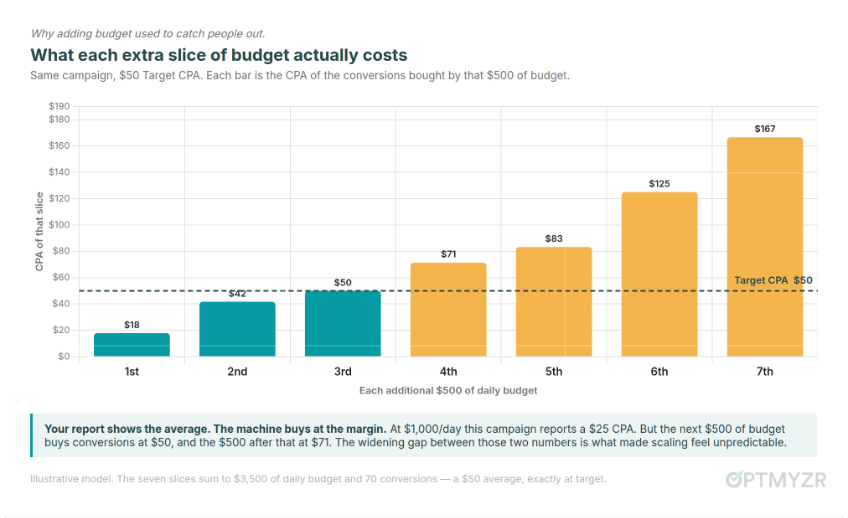
In the Aug 17 update, Google’s stated goal is to make performance more predictable as budgets change.
That is a real benefit.
A target that means roughly the same thing across budget conditions is easier to plan around. It is also much easier to explain to a client or finance team.
What we gain is a more controlled way to scale conversion volume through budget. If the target behaves consistently across budget conditions, an advertiser can set the efficiency objective and use budget as the scaling lever with less surprise about how ROI changes. That does not guarantee unlimited volume or preserve every unit of past efficiency. It makes the relationship between the two controls easier to govern.
But more predictable does not mean infinitely scalable. Available demand remains finite, and Google explicitly says advertisers should not assume that ever-higher budgets will be fully spent at a fixed ROI. The system may deliver more consistently toward a target; it cannot manufacture unlimited profitable demand. Google also advises caution with planning forecasts during the August 17–31 transition window. Both points are covered in their official FAQ.
There is a tradeoff. Advertisers are losing a useful form of dual control. A loose CPA or ROAS target paired with a tight budget could force the system to ration spend toward its best opportunities. That combination let advertisers use the budget cap and target together, even if Google did not intend the target to work that way.
Bottom line: a more literal optimizer makes a well-chosen objective more powerful. It also makes a stale or poorly chosen objective more dangerous.
Four ways Google may be instrumenting this change
Google has not published the exact implementation. In a public clarification, Google Ads Liaison Ginny Marvin said affected campaigns may bid differently and enter different auctions. The final behavior may use more than one of these levers.
That gives us four useful hypotheses and four sets of fingerprints to watch for.
Want to see how the controllers work? Read “What could Google change behind the scenes?” near the end of this article.
Possible actuator | Observable fingerprint | Advertiser response |
Higher auction-time bids | CPC, rank or impression share rises while query and audience mix stays similar | Inspect marginal auction economics; compare lost impression share from budget versus rank |
Different or more marginal auctions | Query, audience, geography, device, CVR or lead-quality mix changes | Audit search terms data and downstream quality of conversions; strengthen exclusions and value signals |
Changes to budget pacing or how strongly bids react to target performance | Spend moves to different times of day, or mature CPA/ROAS moves toward the target faster after a budget or target change | Monitor hourly delivery and evaluate only fully matured conversion data; log every budget, target and tracking change |
Cross-channel reallocation | Performance Max or Demand Gen channel and conversion-action mix shifts | Measure outcomes by channel and conversion action; separate structures where channel control matters |
Mechanisms are analytical hypotheses. Google confirms the bidding change and possible multi-channel allocation shifts in its FAQ.
Want to see why channel mix can move? Read “Why could Performance Max or Demand Gen shift channels?” near the end of this article.
Measure what changed—not just whether Google hit the target
If you watch only CPA or ROAS through this change, every mechanism can look like success once the blended number moves toward the target.
But what had to change to produce that number, and how does that impact your core business metrics?
In click-based Search campaigns with consistent scopes and matured data, CPA can be decomposed into CPC and conversion rate. That makes CPC and CVR useful clues, but not proof. Higher CPC with stable CVR does not automatically mean higher-intent or more incremental traffic. Lower CVR does not by itself prove query dilution.
I would watch the change in three layers:
- Platform economics: spend, impressions, clicks, CPC, conversion rate, conversions or value, and lost impression share from budget versus rank.
- Traffic composition: queries and query categories, audiences, device, geography, network, channel, product and conversion-action mix.
- Business outcomes: qualified leads, average order value, margin, pipeline, closed revenue, new versus returning customers and incrementality.
Google says unconstrained Target CPA and Target ROAS campaigns are not changing, which creates a useful—though imperfect—control cohort. Compare affected campaigns with similar unconstrained campaigns rather than attributing every August movement to the rollout. Because the update rolls out over several weeks, avoid treating August 17 as a clean one-day experiment. The scope distinction is documented in Google’s FAQ.
A Google Ads target is not your business objective
The most important number in this system should not come from Google Ads.
It should come from the economics of the business and then be translated into Google Ads.
A defensible CPA or ROAS target may need to incorporate gross margin, lifetime value, lead-to-sale rate, returns, new-customer value, incrementality, measurement uncertainty and the profit buffer the business wants to preserve.
Recent actual performance is evidence, not strategy. It can help you calibrate a target. It cannot tell you what a conversion is worth.
This makes conversion definitions and values more important, not less. Target ROAS can only optimize the values the advertiser reports, and Google’s own Target ROAS documentation recommends using conversion values and value rules that reflect the business. Duplicate leads, low-quality form fills, flat values and missing offline outcomes become more damaging when the optimizer follows the target more literally.
Let Google fly the plane but keep control of the flight plan
Do not even think about taking back bidding from the machine.
Google is better positioned to process signals and set a bid in the milliseconds before an auction. There is no good reason for a human to try to out-calculate Smart Bidding one auction at a time.
But autopilot does not decide where the plane should go.
You still choose the destination, supply the instruments, and watch for a warning light. In PPC terms, that means defining the objective, feeding the right conversion data and putting an independent layer of monitoring and control around Google’s automation.
Google’s automation | Your automation layer on top of Google's |
Predict conversion probability and value | Define which conversions count and what they are worth |
Set auction-time bids | Translate business economics into target bands and budget envelopes |
Allocate traffic within campaign structures | Separate materially different economics, audiences or channels |
React to auction-time signals | Audit traffic quality, profit and incrementality independently |
Optimize continuously | Govern target changes with rules, alerts, approvals and change logs |
At Optmyzr, we have long called this automation layering: use your own measurement, rules and accountability on top of the execution supplied by the ad platforms. The better the platform becomes at running the inner loop, the more important the advertiser’s outer loop becomes.
This is why losing the old dual-control tactic does not make automation layering less relevant. It makes it essential. Google operates the plane’s mechanics: the auction-time math, pacing and choice of auctions. The advertiser’s automation layer defines and enforces the flight path around those mechanics. It watches business outcomes and changes budget, target, structure or data inputs when the plane starts drifting from the destination.
That outer loop can restore a more deliberate version of the control advertisers are losing. It can increase budgets when qualified conversions are scaling within the real business constraint, tighten targets when marginal economics deteriorate and alert a human when the platform’s blended CPA or ROAS hides a change in traffic or lead quality.
Operating principle: Let the machine run the bids. Keep a human in charge of the objective.
What advertisers should do now
- Build an exposure inventory. Review every affected campaign that has been limited by budget, not only campaigns showing the status today. Include portfolio strategies and shared budgets, where target changes may need to be made at the portfolio or shared-budget level.
- Baseline the right numbers. Compare matured actual performance with the date-matched Average target CPA or Average target ROAS. Do not compare a 90-day result with today’s target setting. Exclude the conversion-delay window.
- Diagnose the gap before closing it. Was it deliberate headroom, a stale setting, a measurement problem, or the result of scarce budget selecting only the best opportunities? The same percentage gap can require very different action.
- Decide which knob matters most. If efficiency is the hard constraint, set a true business target and provide budget headroom. If budget is inflexible and volume is primary, Maximize Conversions or Maximize Conversion Value may fit better—while accepting that ROI can fluctuate. If the business requires both, use an external feedback loop that monitors spend and business outcomes and governs target changes.
- Strengthen the objective before granting more auction freedom. Import qualified or offline outcomes, deduplicate conversions, use defensible values, distinguish new customers where relevant and audit whether reported conversions are incremental.
- Preserve causal insight. Snapshot settings and baselines, annotate every change, use affected and unaffected cohorts, change one major variable at a time, and wait one to two full conversion cycles before judging results. Google advises the same stabilization window and warns in its FAQ that forecasts may be inaccurate from August 17–31.
- Do not add controls reflexively. Google specifically advises against adding data exclusions or new bid limits solely because of this update. Add exclusions or structural controls only when the observed traffic and business evidence justify them.
For readers who want the math
You do not need the equations to act on this update. But if you want to see why these mechanisms are economically plausible, Google researchers have published the building blocks in their survey, “Auto-bidding and Auctions in Online Advertising”. This is a research model, not a disclosure of the August 17 production code. Still, the formulas make the logic much easier to see.
Why can my campaign beat its target when the budget runs out first?
The paper models a value-maximizing bidder with two constraints: a budget and a return-on-spend target. Its bid formula uses one shadow price for budget scarcity (αB) and another for pressure from the target (αT). The parameter τ represents the required return: for tROAS it is the target return multiple; for tCPA with one unit of value per conversion, it is the inverse of the CPA target.
bⱼ = [(1 + τ·αT) ÷ (αT + αB)] · vⱼ
Here is the revealing case. If the campaign exhausts its budget while comfortably beating the target, the budget constraint is active and the target constraint is slack. Standard optimization logic sets αT to zero, reducing the formula to
bⱼ = vⱼ ÷ αB
The target (αT) has not been violated or ignored. It simply drops out of the marginal bidding decision because scarce budget—not the efficiency guardrail—is controlling which auctions the system can buy. That is the mathematical version of the target-actual gap we have been discussing.
See Sections 2.1 and 3.1, especially Equation 7, in the Google-authored survey.
What could Google change behind the scenes?
The paper says these shadow prices can be estimated from past data and updated through control loops. It also summarizes research showing that budget pacing and return-on-spend pacing perform poorly when they are fully decoupled, while even limited coordination can approach the fully coordinated optimum. That gives Google several possible knobs: coordinate the two feedback loops more tightly, give target error more influence over bids, change how quickly the system enters marginal auctions, or treat the target more like a setpoint than an inequality guardrail. The paper does not tell us which knob Google is turning on August 17. It does show that changing the coordination between budget and target controllers can change bidding behavior without changing the auction itself.
See Section 3.2 in the Google-authored survey, including its discussion of joint feedback loops for budget and return-on-spend constraints.
Why could Performance Max or Demand Gen shift channels?
The multi-channel section models an advertiser maximizing total conversions under one global budget and return-on-spend constraint. The research it summarizes finds that optimizing only per-channel targets can perform far worse than the global optimum, while reallocating per-channel budgets can reach that optimum in the model. Another result characterizes the solution as equalizing marginal CPA across channels. In practical terms, a change in how Google balances the global budget and target can produce a new mix of Search, YouTube, Display or other inventory—even if the blended CPA or ROAS simply moves toward the same campaign target. That is why channel-level outcomes belong in the advertiser’s outer control loop.
See Section 6.2, “Multi-channel,” in the Google-authored survey.
Don’t take back the bid. Take control of the objective.
I do not see this as a reason to retreat from Smart Bidding. The machines are good at the math, and they are getting better.
But a machine that follows instructions more closely makes the quality of those instructions more important.
The target-actual gap was information. It told us something about scarcity, selection and the marginal opportunity curve. After August 17, we need to keep looking for that information in CPCs, traffic mix, channel allocation and downstream business quality.
This is the sweet spot I keep coming back to: humans plus machines. Let Google handle the auction-time calculation. Let experienced marketers set the objective, inspect the result and guide the machine.