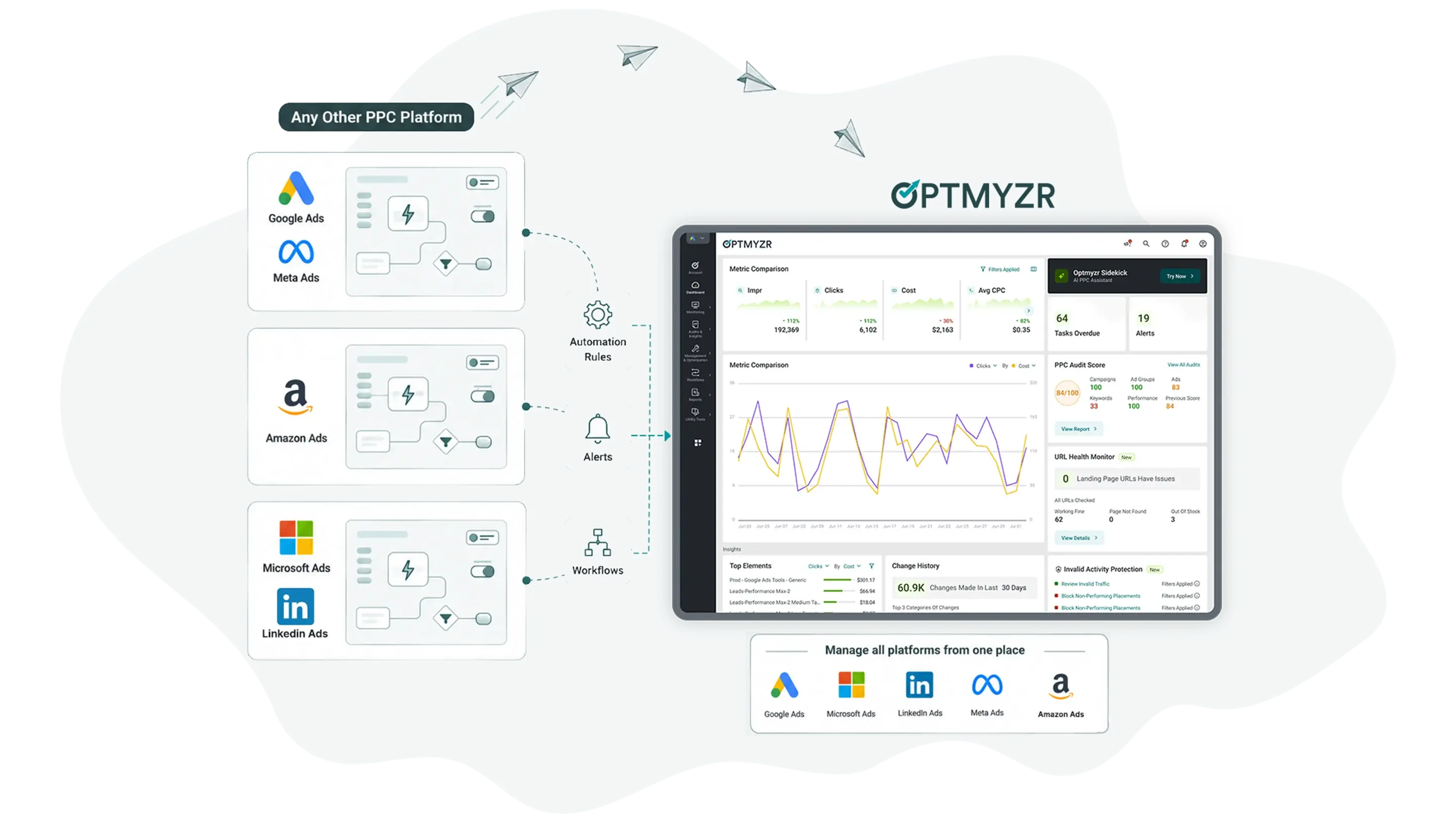
Optmyzr is a multi-platform PPC management suite for agencies and enterprise PPC teams covering Google Ads, Microsoft Ads, Amazon Ads, and Meta. It combines automation (Rule Engine), reporting, bid management, and account auditing in a single platform built for advertisers managing significant ad spend across multiple accounts and channels.
Best for: PPC agencies, freelancers, and in-house teams who manage search, shopping, and Amazon as a dedicated discipline and need deep tools that go well beyond automation.
Markifact
Markifact is a general-purpose AI marketing automation platform. The three modes, Agents, Workflows, and MCP, let marketing teams run automated tasks, build visual workflows, and connect external AI tools to their marketing data. The platform helps integrate with ad platforms, analytics, CRM, e-commerce, workspace tools, and messaging.
Markifact is designed with a breadth of operations for marketing teams who operate across many different channels and tools and want one AI layer connecting all of them.
Best for: Marketing teams and agencies who need to automate work across ad platforms, analytics, and reporting.
Which tool fits which buyer
Choose Optmyzr if…
PPC is the actual job
You run Google, Microsoft, Amazon, Meta, and LinkedIn and want it all managed in one place.
You manage Amazon Ads campaigns, not just pull reports from them.
You want to set guardrails to your automations and see every change they make before running, not just approve a task.
You want to analyze performance changes including what, why, and how it changed.
You need to know which keyword or campaign caused a shift, with a tool built to show you.
You run Shopping and Performance Max from product feeds.
You want flat, predictable pricing that doesn’t increase as you run more automations, audits, or reports.
Choose Markifact if…
Your work runs wide
You automate tasks across many tools and channels, not just paid search and shopping.
You want to build custom workflows for things like data pipelines, Shopify alerts, or CRM routing.
You need to bulk-upload creative to Meta and TikTok from a Google Sheet.
You want to choose your AI model and bring your own keys.
You want a marketing agent your team can reach on Slack or WhatsApp.
You’re comfortable with variable credit-based pricing and monitoring usage as part of your workflow.
Where each tool is genuinely stronger
Optmyzr leads on depth and business intelligence
For teams whose day is Google, Microsoft, Amazon, Meta, and LinkedIn, Optmyzr was built around the work itself. While general automation tools prioritize simple connectivity, Optmyzr prioritizes the logic behind every click.
Optmyzr’s team has spent 12+ years building a PPC-specific business intelligence layer that powers every suggestion, turning raw performance shifts into clear, actionable answers so you can make surgical fixes rather than guesses.
Teams move to Optmyzr because they need that platform-specific depth: multi-account management, white-label reporting, and change-level preview systems engineered to scale and supported with business intelligence, ensuring that automation never outpaces your strategy.
Markifact leads on reach and flexibility
If your work runs across many tools and channels, Markifact is built for that spread. Running one AI layer across your platforms, choosing your own AI model, building workflows for tasks well outside paid search, and deploying agents to Slack or WhatsApp are all things it does well.
For generalist marketing teams and agencies running broad cross-channel programs, that reach is the appeal. The customers who like it most tend to praise the interface and the time it saves on manual reporting work.
The tools that come with being PPC-first
Specialist tools don’t come standard with a broad automation platform. That’s the line between reading a platform and managing it. Markifact connects across a wide set of platforms and can write changes to them. The part that takes years to build is the intelligence layer that decides what those changes should be: the bid logic, the search term analysis, the audit scoring, the diagnosis when something breaks, all of this backed with years of gathered business intelligence. That’s the part Optmyzr has spent over a decade building.
Rule Engine with a preview step
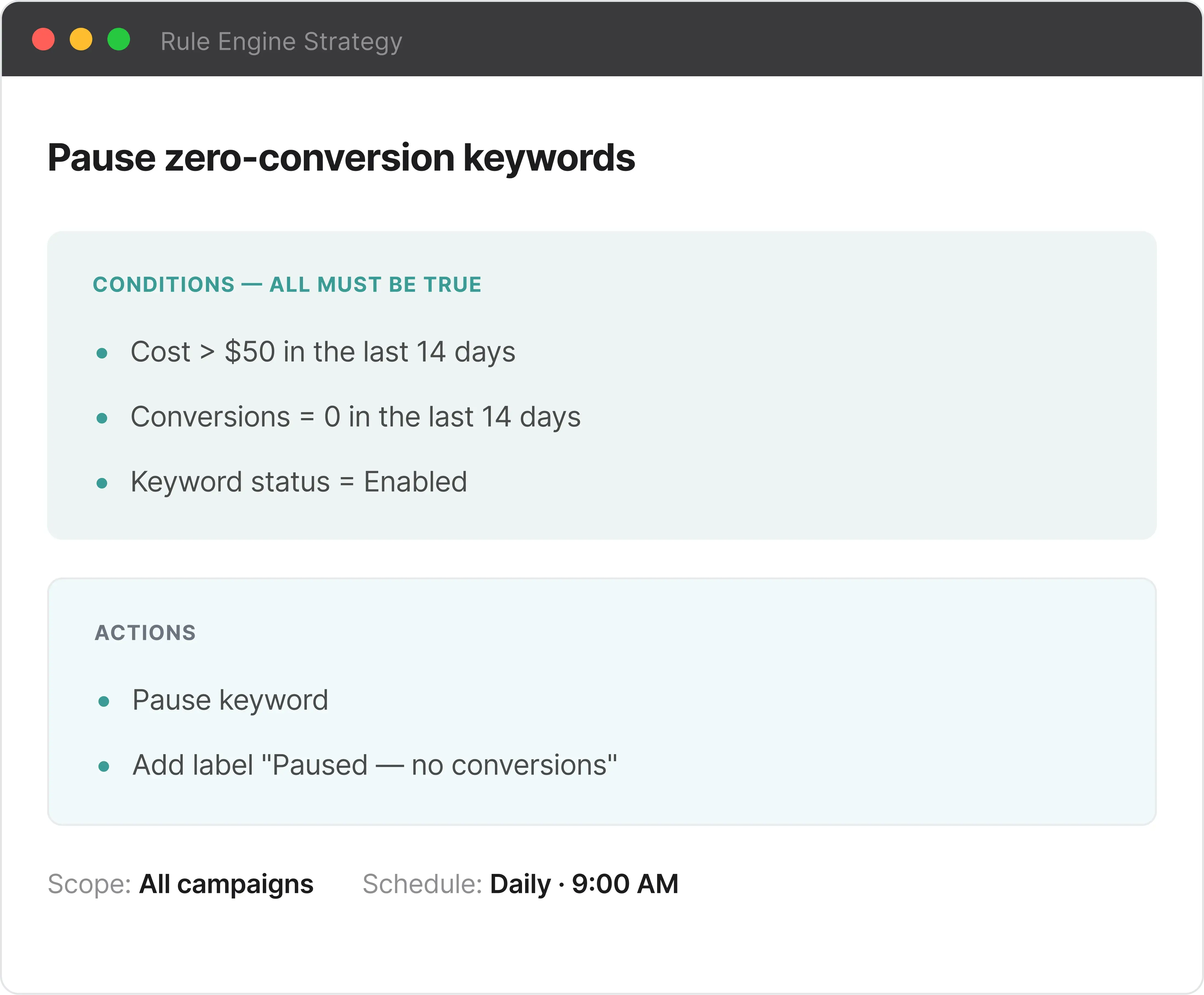
Every automation recipe can run in “View Suggestions” mode before anything goes live. You see the full list of proposed changes, every bid adjustment, budget shift, and keyword pause, across every campaign and account, then approve, edit, or discard them one by one or in bulk. The automation never gets ahead of you.
AI-powered campaign creation from a URL
Give Optmyzr a URL and an optional business description, and the AI builds a complete campaign: ad groups, keyword themes, headlines, descriptions, and assets for Google Search or PMax Lead Gen. A preview and inline editing step comes before anything reaches your account. The structure is built from your actual page content, so you start from something real, not a blank form.
Bid and optimization intelligence
Our optimization layer is the reason teams stay. Bid management adjusts to your targets. Search term mining turns raw queries into negative keyword lists and expansion ideas. N-gram analysis finds the patterns hiding in those search terms, and Quality Score tools point at what's dragging performance down. Individually, those are actions. Together they form a judgment layer, the part that tells you which change is worth making, based on your own historical data and more than a decade of building tools for PPC teams. Any tool with a platform connection can execute a change. Working out which change is worth executing is the harder problem, and it's the one we built for.
Root cause, not root guess
When performance drops, Markifact’s agent can analyze your data conversationally and offer likely explanations. That’s useful for a quick read.
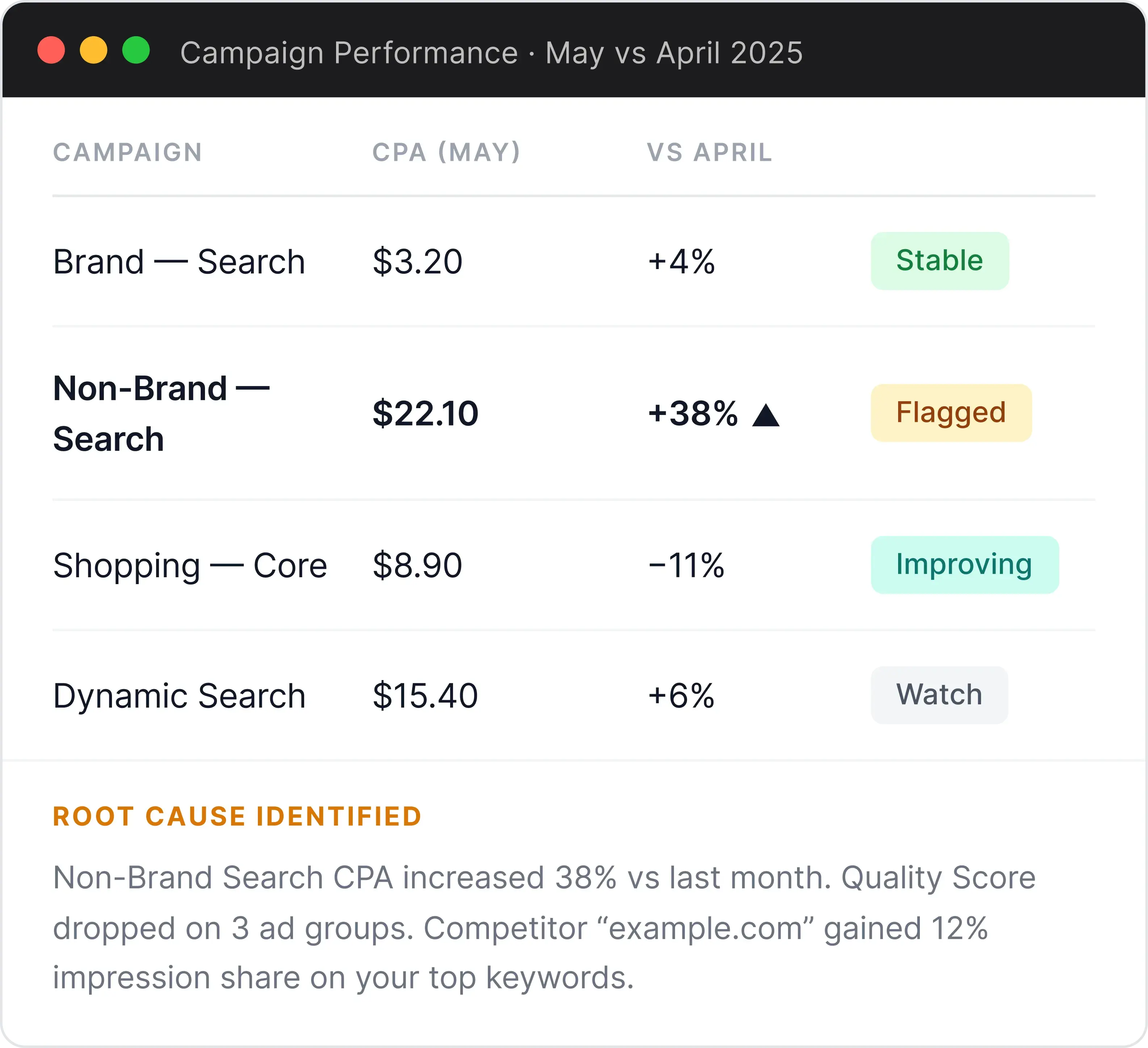
Optmyzr’s PPC Investigator is a dedicated tool that goes beyond that. Pick the metric, pick the date range, and it returns Cause Charts showing how your metrics relate to each other, plus a Root Cause Analysis that drills down to the names of the specific campaign, keyword, device split, or network behind the change.
Amazon Ads, all the way to campaign level
In Markifact, you can pull performance data and build automated Amazon reports. Campaign creation, bid management, and optimization are not part of it.
Optmyzr manages Sponsored Products, Sponsored Brands, and Sponsored Display alongside Google and Microsoft, and the Rule Engine reads Amazon Seller Central organic data, inventory, Buy Box percentage, returns, so your automation factors in the business, not just the ad metrics.
Ask AI about your PPC accounts. Get real answers from live ad data.
Get a budget summary before a client call
Pull spend, ROAS, and budget pacing across all your accounts for the last 7 days, formatted and ready before you walk into the meeting.
Prompt
Summarize spend and ROAS by account for the last 7 days. Flag any pacing more than 15% over budget.
Give Sidekick a URL and a brief, and it builds the full campaign structure, previews it for your review, and applies it to your Google Ads account from the same conversation. No switching between tools.
Prompt
Create a Google Search campaign from this URL. The product is cotton newborn onesies with matching mittens and socks. Group by category, suggest keywords with intent context, write ad copy for each group, and show me the preview before anything goes live.
One-click connection via Claude Settings → Connections → Optmyzr. The fastest setup — no manual configuration needed.
Requires paid Claude plan
ChatGPT
Live
Connect via the Optmyzr MCP server URL in ChatGPT Settings. Full access to all capabilities once configured.
Manual URL configuration
Any MCP-Compatible Tool
Live
Cursor, Windsurf, n8n, or any tool that supports MCP server connections can access your Optmyzr data the same way.
Manual configuration
How each tool charges
Based on publicly available information.
Optmyzr
From $209/month
Tiered by monthly ad spend under management. All platforms are included on every plan, with no per-seat charges. Annual billing saves 30% against the monthly rate.
Rule Engine, reporting, and account audits on all plans
Google, Microsoft, Amazon, Meta, and LinkedIn Ads
AI Sidekick Assistant and Optmyzr MCP
Agency features on higher tiers
14-day free trial, no credit card required
Markifact
From $79/month
Credit-based. Cost varies by what you run, which platforms are connected, and which AI model handles the task.
Pro: $79/month — 2,000 credits, 1 seat
Team: $249/month — 10,000 to 100,000 credits (tiered), 10 to 50 seats
Managed: custom pricing
Free signup includes 200 one-time credits
Note: The $79/month starting price is not fixed in practice. 2,000 monthly credits covers roughly 3–5 daily workflows across a handful of accounts before the balance runs low. Teams running more accounts or more complex automations typically need the Team plan or higher. See FAQ for a worked example.
Switching to Optmyzr doesn't mean rebuilding from scratch
Our Platform Migration Service replicates your existing setup — automations, reports, and workflows — inside Optmyzr. You don't have to start over.
Markifact is a general-purpose AI marketing automation platform. It connects your entire marketing stack across ad platforms, analytics, reporting pipelines, and data tools, and lets AI run across all of it. Optmyzr is a PPC management platform built specifically for the daily work of managing paid search, shopping, and Amazon. There is a significant overlap: both have AI agents, both have MCP, both support Google and Meta, but Markifact goes wide while Optmyzr has deeper features especially for PPC management.
Not the specialized parts. Markifact can create campaigns, adjust bids, run reporting workflows, and respond to performance questions in chat. What it doesn’t have is a dedicated root-cause analysis tool, a built-in scored account audit with one-click fixes, Amazon Ads campaign management (only reporting), a Shopping Campaign Manager that builds from a product feed, or a change-level preview that lists every individual proposed change before it runs. Those tools exist in Optmyzr because the platform was built specifically around PPC work.
Both have MCP but the data and operations they expose are different. Markifact’s MCP connects across a broad set of marketing platforms. Optmyzr’s MCP has functions built specifically for PPC use cases: performance reporting, Rule Engine strategy generation from plain English, competitor analysis, and alert management. If your MCP use case is PPC, Optmyzr’s version is purpose-built for that.
Markifact runs on credits. Every workflow run, agent task, and MCP operation draws from a monthly balance. Most connection nodes cost 1 credit each, AI nodes run from 1 to around 20 depending on the model.
Markifact charges per operation. Every workflow run, every agent task, and every MCP query draws from a monthly credit balance. The Pro plan starts at $79/month and includes 2,000 credits.
To understand what 2,000 credits gets you, it helps to see how a single workflow is cost. Take a standard daily cross-channel reporting workflow pulling data from Google Ads, Meta, GA4, and writing the output to Sheets with an AI-written summary. That's 10 nodes, broken down like this: ● Read from Google Ads: 1 credit ● Read from Meta Ads: 1 credit ● Read from GA4: 1 credit ● Read from a second source (another ad account or view): 1 credit ● Merge and filter the data (utility nodes): 0 credits ● AI node to analyze & write the summary: 7 credits for GPT 5.2 ● Format the output (utility node): 0 credits ● Write to Google Sheets: 1 credit Send a Slack notification: 1 credit ● Workflow run itself: 1 credit
That's 14 credits per run. Run it daily for a month and it costs 420 credits per account.
On the Pro plan's 2,000 credits, that one workflow across 4 client accounts uses 1,680 credits, nearly the entire monthly balance, before a single audit, budget check, or ad-hoc agent query.
For anyone running more than a handful of accounts, the Team plan at $249/month (10,000 credits) is where agency work actually starts. Here's what a standard set of workflows looks like across 10 accounts: ● Daily cross-channel reporting (10-node) across 10 accounts: ~4,200 credits/mo ● Daily budget pacing monitor across those accounts: ~3,600 credits/mo ● Weekly audit workflow across 10 accounts: ~1,500 credits/mo ● Ad-hoc MCP and agent operations: ~2,500 credits/mo
Running total: ~9,300 of 11,800 credits
(Credit cost figures are illustrative based on Markifact's published per-node guidance.)
Three routine workflows across 10 accounts exceeds the base Team plan's 10,000-credit allotment. You'd either need to drop to a lighter model — which affects output quality — or move to a higher credit tier above $249/month.
Optmyzr charges a flat fee from $209/month regardless of how many automations, audits, reports, or Sidekick AI sessions you run that month. The more you automate on Optmyzr, the better the value per dollar. On Markifact, the more you automate, the closer you get to the next cost tier.
Markifact added Amazon Ads reporting in December 2025. You can pull performance data and build automated reporting workflows. Campaign management — creating, optimizing, and managing Amazon campaigns — is not supported. Optmyzr manages Sponsored Products, Sponsored Brands, Sponsored Display, and Sponsored Brand Videos, and the Rule Engine reads Amazon Seller Central organic data alongside ad metrics.
For a team running TikTok, Snapchat, Reddit, and Pinterest alongside paid search, Markifact’s breadth is a genuine advantage. For a PPC team whose spend concentrates on Google, Microsoft, and Amazon, the extra platforms are coverage for work they’re not doing, and the trade-off is shallower tooling on the platforms they run every day. Optmyzr covers fewer platforms and goes significantly deeper on each of them.
Sidekick is Optmyzr’s built-in AI. What you can do is connect Claude, ChatGPT, Cursor, and other external AI tools to your Optmyzr data through MCP, and use those tools to query performance, analyze accounts, and build Rule Engine strategies.
Yes, 14 days of full platform access, no credit card required. The customer success team helps you connect your accounts, get set up, and make the most of the trial. Markifact offers 200 one-time credits at signup, which is enough for initial exploration.