


Your product feed should drive your campaigns. With Optmyzr, it can.
Your catalog changes by the hour: new products, shifting ROAS, low stock, budgets on the move. Your campaigns should keep up without you catching every change by hand.
 Google Ads
 Microsoft Ads
 Amazon Ads
 Meta Ads
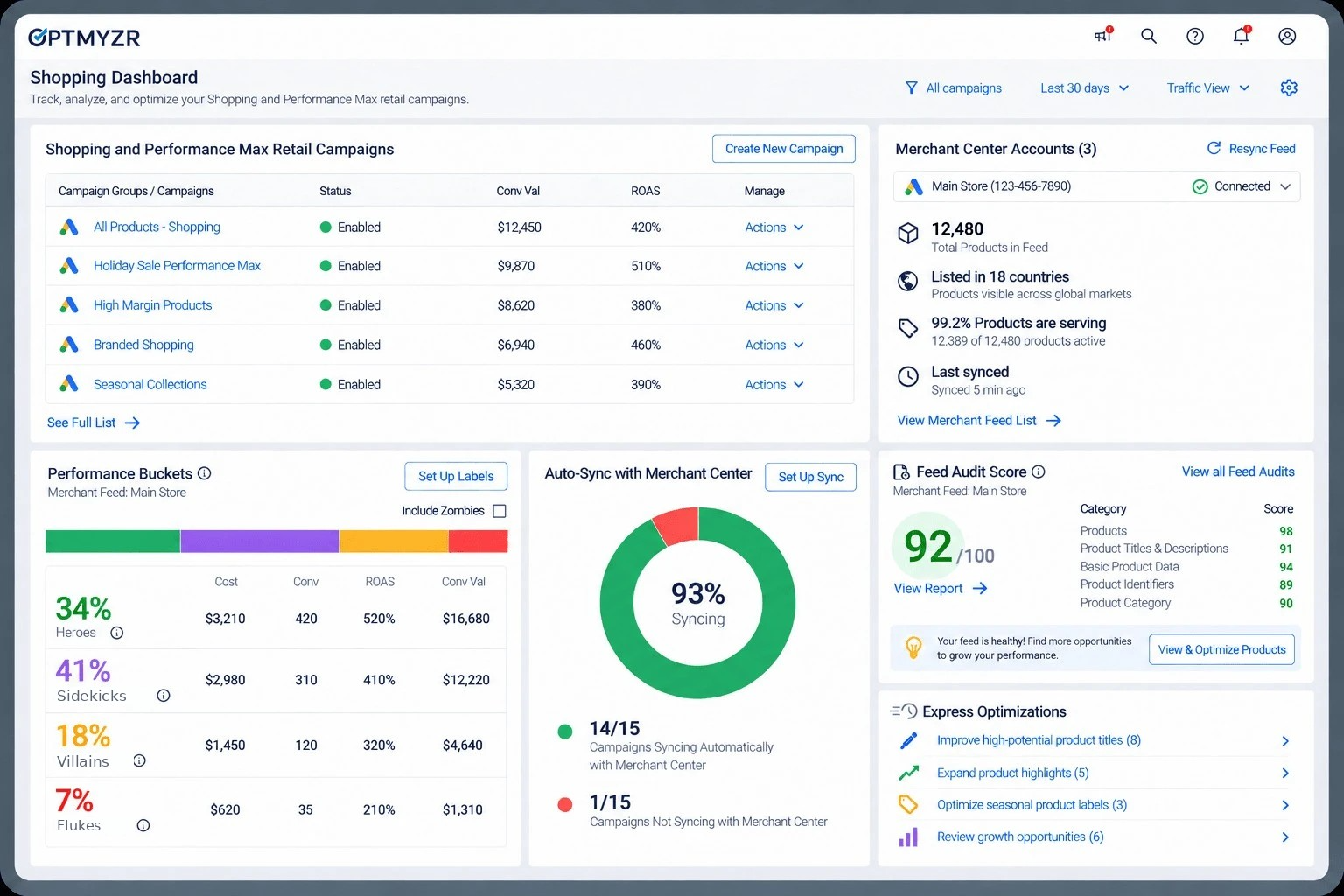
Paid media and digital marketing teams use Optmyzr to make PPC management easier




Your feed optimization tool and your PPC tool can finally be the same thing.

How Optmyzr makes ecommerce campaigns manageable at scale
Keep campaigns in lockstep with a catalog that changes every day
Shopping Campaign Management

Catch feed issues before they cost you impressions
Feed Audit
The Feed Audit and Express suggestions surface issues continuously in your main dashboard with AI-generated fixes for missing titles, descriptions, and links. And the Out-of-Stock Products Alert flags inventory changes in real time so spend pauses before it burns.
While Feed Audit focuses on product feed and shopping-related issues, the PPC account audit helps review broader account structure.

Label your products by how they actually perform
Smart Product Labeler
Smart Product Labeler groups your products from Google and Microsoft Ads into performance tiers (Heroes, Sidekicks, Villains, Zombies, and Flukes) and writes those labels back to Merchant Center as a supplemental feed, which takes priority over your primary feed during syncs. Once products are labeled, you can build campaign structure around them with separate budgets and bids for each.

Build hundreds of campaigns from your feed in minutes
Campaign Automator
Campaign Automator builds search, display, and PMax leadgen campaigns, while Shopping Campaign Management manages your Shopping campaign creation based on whatever rules you set (brand, category, performance label, custom attributes). So when your catalog changes, the campaigns update automatically.

See exactly where PMax puts your money
Performance Max Visibility
PMax Channel Distribution shows spend breakdown by channel inside your PMax campaigns. And Shopping Analysis gives you product-level visibility into which SKUs are driving results and which are just eating budget. And when you want to keep your Shopping and PMax campaigns from competing for the same queries, Traffic Sculptor can step in.

Stay ahead of budget surprises across every channel you run
Cross-Platform Budgets

Keep your finger on the pulse during peak sale days
Sale Day Command Center
The Sale Day Command Center gives you a live dashboard across Google Ads, Microsoft Ads, Amazon Ads, and Meta Ads that refreshes every 30 minutes. When something dips, you catch it while the sale is still live.

Manage Google, Microsoft, Amazon, and Meta from one dashboard
All Accounts Dashboard

Give your team back the hours that reporting eats every week
Custom Reporting

Audit inherited accounts and rebuild what's broken
PPC Account Audit
PPC Account Audit runs dozens of checks across a dozen categories for Google, Microsoft, and Amazon Ads, and gives you a scored breakdown of where the account structure is outdated, missing best practices, or working against your bidding strategy.
While PPC Account Audit looks at your broader account structure, Feed Audit covers your product feed and Shopping-specific issues.

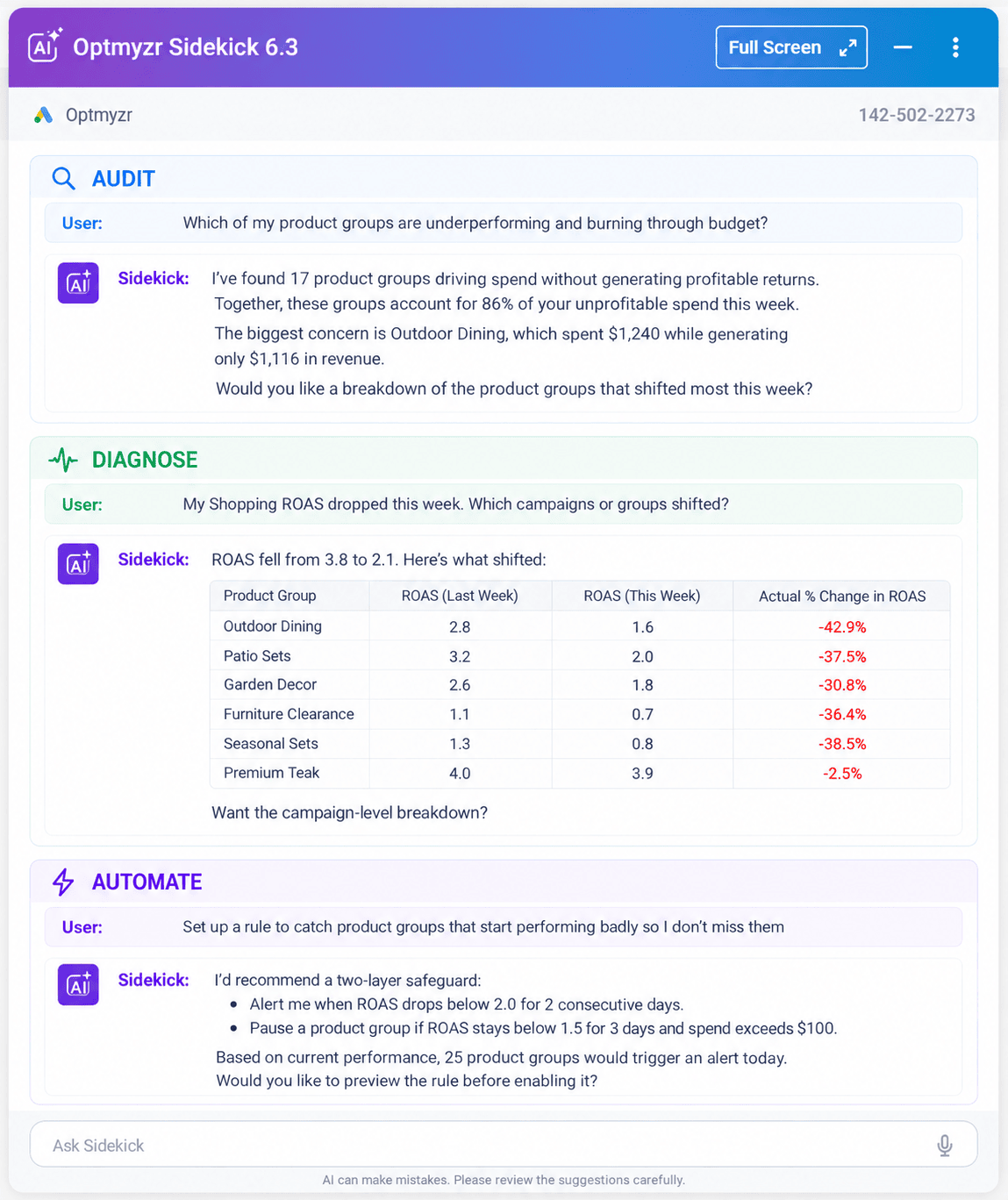
Sidekick understands your account. Most AI tools don't.
From a single conversation, you can build a full Shopping campaign from your feed, pause products draining budget, create Rule Engine strategies, adjust budgets across campaigns, set up portfolio alerts, and get a full performance report — all applied directly, no switching tools.
For teams already in Claude or ChatGPT, the Optmyzr MCP connects your ad account directly to your preferred chat platform, so you get the same live account actions without switching windows.
Optmyzr at Scale
Built to handle the most demanding e-commerce catalogs
in ad spend processed over the last 12 months
on average saved by parent users
ad accounts linked across Google, Microsoft, Facebook, Amazon, and LinkedIn
active automations running continuously
Built for ecommerce teams managing PPC at scale
Optmyzr for ecom agencies
Build once, run across every client account
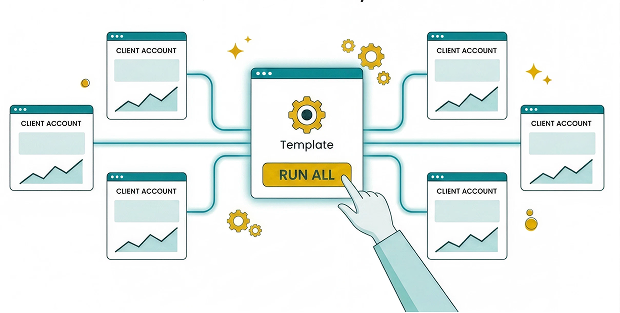
Optmyzr helps account managers spend time on strategy instead of campaign formatting, and build a portfolio that scales without proportional team growth.
- Keep campaigns automatically aligned with each client's catalog
- See portfolio budget pacing in one view
- Turn weekly reporting into templated, branded documents
- Replicate your best automation logic across accounts
Optmyzr for in-house ecom teams
Take back control of your budget and accounts
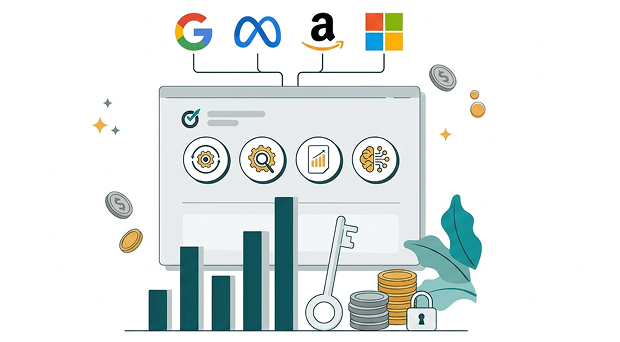
Optmyzr helps automate campaign structures and monitor your budgets so your team spends more time on decisions and less on maintenance.
- Keep thousands of SKUs in lockstep with live campaigns
- See exactly which products are driving PMax results by ROAS tier, category, or margin
- Catch budget and performance issues early
- Combine cross-platform reporting without manual stitching
Optmyzr for ecom consultants
One person, thousands of SKUs, full visibility

Optmyzr gives consultants the infrastructure to build any logic once and run it across their entire client book.
- Build custom segmentation and margin-driven automation once and run it across your client book
- Set a clear audit trail behind every decision
- Manage multiple high-spend accounts without constant tool switching
- Anchor your retainer to logic clients genuinely can't rebuild in-house
Used by ecommerce teams managing millions in Shopping spend
conversion value growth YoY
to set up shopping campaigns, down from 5 hours
added in conversion value during peak season for a client
Setting up shopping campaigns in Optmyzr takes minutes, not hours. Optmyzr is so integrated with the way we work now that we don't really measure the time savings anymore. It's just how we operate.


Try it with your own account
Connect your Merchant Center, run a feed audit, and see what the workflow looks like. Want help with setting up? Our team can help.


FAQs
Shopping Campaign Management addresses this by monitoring your feed for product additions, removals, and changes, and adjusting campaigns automatically. Combined with Smart Product Labeler keeping performance segments current, the campaign structure stays aligned with the catalog without manual rebuilds.
For accounts where the catalog changes frequently — seasonal products, large retail inventory, daily pricing updates — this is what makes the difference between a campaign structure that works this week and one that worked six months ago.
Smart Product Labeler writes to a supplemental feed, which takes priority over the primary feed only for the fields it touches — your performance labels. Everything else in your primary feed stays untouched. Your feed syncs keep running normally, and the labels Optmyzr sets don't reset.
So if you've built segmentation logic around hero/sidekick/villain tiers or custom performance buckets, that structure holds across syncs instead of disappearing every time your feed updates.
The answer is yes. Shopping automations—which include the Rule Engine, Smart Product Labeler, and Shopping Campaign Management—all run through visible logic, not a black box.
You set the logic (pause products spending over $100 with zero conversions, adjust bids when ROAS drops below a threshold,label products based on performance, and automate creating campaign structures), and you can see exactly what each rule did and why. Nothing fires without a clear audit trail.
For agencies, the other big thing is that you can replicate a rule across your entire client book in one click instead of rebuilding the same logic account by account.
The practical upside for ecommerce teams running both marketplace and search is when your Amazon ACOS spikes and your Google ROAS holds steady, you see that in one view and can shift budget in the same session instead of logging into two tools and comparing screenshots.
Along with that, Optmyzr handles the automation layer on top: campaign building from feed data, performance-based product segmentation, budget pacing, cross-platform reporting, PMax visibility. Most ecommerce teams we work with end up consolidating two subscriptions into one, which means less cost and fewer places where things can fall out of sync.
One thing worth checking in your own account: Optmyzr's analysis of ecommerce accounts found that PMax frequently cannibalizes Search, including exact match, so checking for that in your account is a useful starting point for understanding what the campaign is actually doing.
If you want to go further, Sidekick can build a full Shopping campaign structure from a single prompt using your live feed and account data. For teams managing large catalogs where campaign builds used to take a full day, this is usually the feature that changes the math on whether scaling is feasible without adding headcount.
When you’ve had a bad end-of-quarter or mid-BFCM moment where overspend surfaced too late to fix, this tool can help catch those problems while there's still time to act.
The Shopping Feed Audit surfaces these issues continuously in your main dashboard, groups them by type, and suggests AI-generated fixes for missing titles, descriptions, and product types. And you can also make bulk corrections right from within Optmyzr.
Where it goes further than a standard reporting tool is at the product level. The Top Performers widget lets you include individual SKU performance in those same scheduled reports — item ID, product image, brand, ROAS, cost, conversions — for both Standard Shopping and PMax campaigns.
For agencies running multiple ecommerce accounts, the data is specific enough to make product-level decisions.